Check crown depth and seam contact when comparing hats
A headwear size can describe the circumference while leaving the depth unclear. A cap with the right band may still rest on your ears, and a beanie that stretches comfortably can put its fold in the wrong place.
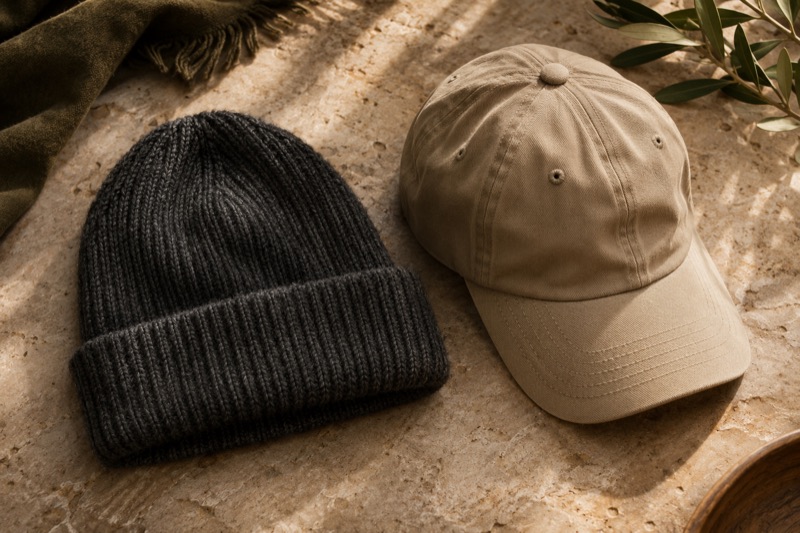
Write down where each reference touches
Try a cap and a folded beanie that you own. Note where each front edge sits relative to your eyebrows and where the sides land near your ears. If one seam becomes distracting after ten minutes indoors, mark that contact point in a quick sketch.
Measure depth the same way each time
For a cap, use a tape to follow the inside front from the lower edge to the centre of the crown and record the starting and end points. For a beanie, lay it flat with the fold at your usual height and measure vertically from the folded edge to the top. A taller fold reduces the depth available below the crown and changes where the band contacts your head.
Separate a loose strap from a deeper crown
Imagine caps A and B both adjust to your preferred 57 cm setting. A deeper crown can settle lower and touch the tops of your ears even at the same setting. Ask for a side photo showing the distance between the band and the crown rather than trying to infer it from the strap length.
Describe the fit with a position
Try a note like ‘Band fits at 57 cm, side edge should sit above the ears’ or ‘Folded height 20 cm, keep seam away from forehead’. A position and a measurement give you something to compare next time a spreadsheet lists only one size.